Upper Swan, Southwest WA
Site name: Upper Swan
Sample ID: SUA-1500
Phase calibrated kya: 44.0 +/- 1.8
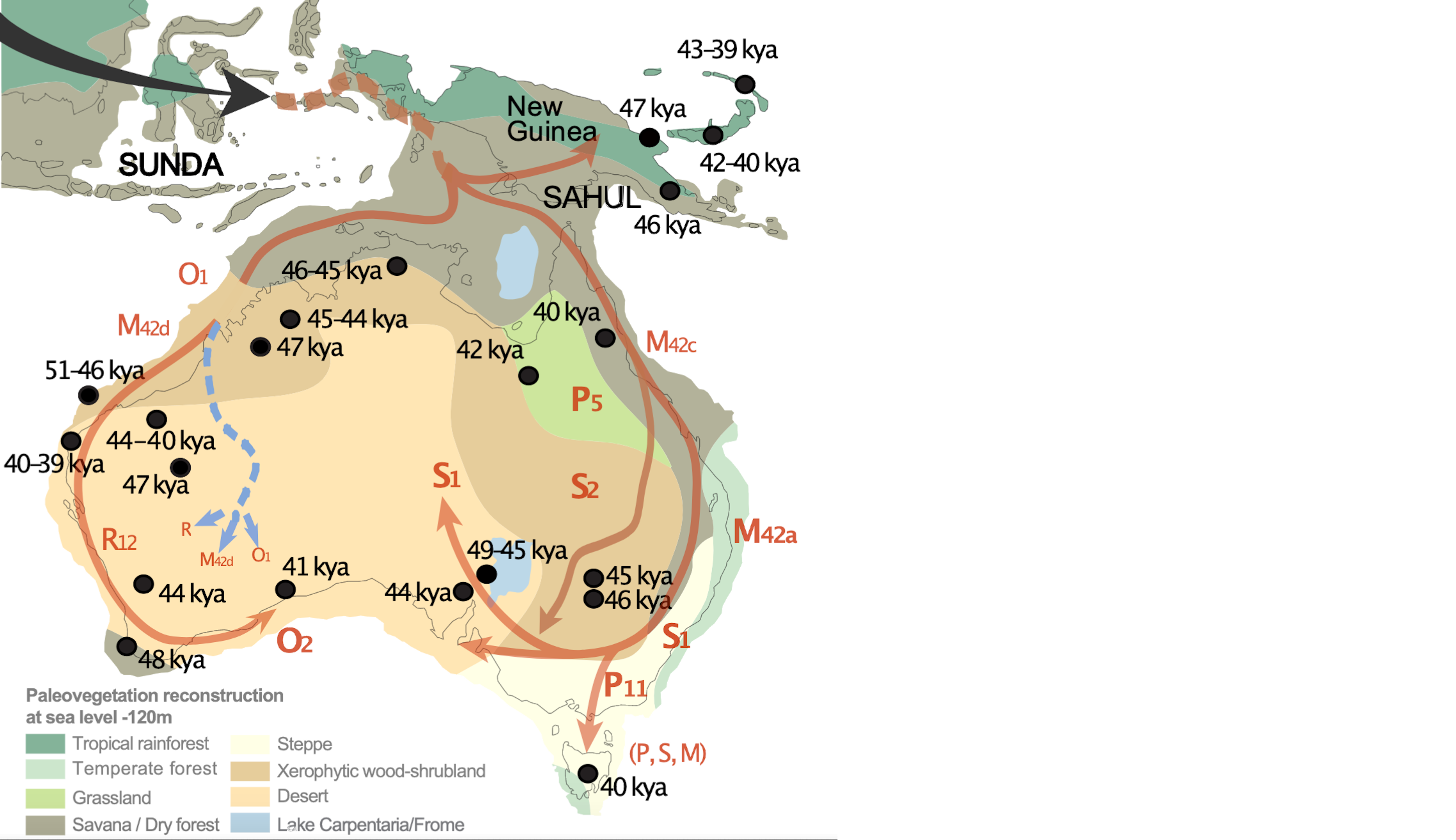
The movements of ancient Aboriginal people can be discerned from their mitochondrial DNA, or mtDNA. This map shows the path that they took over the ancient landmass of Sahul (modern day Australia and New Guinea).
Click on any of the arrows or points to learn more!
Site name: Upper Swan
Sample ID: SUA-1500
Phase calibrated kya: 44.0 +/- 1.8
Site name: Devil's Lair
Sample ID: ANUA-11512
Phase calibrated kya: 47.8 +/- 1.5
Site name: Unknown
Sample ID: ????
Phase calibrated kya: ???
Lorem ipsum...
Site names: Jansz
Sample ID: WK-1513
Phase calibrated kya: 39.5±0.6
Site names: Mandu Mandu
Sample ID: WK-1513
Phase calibrated kya: 39.3±1.0
Site name: Ganga Mara
Sample ID: Wk-38073
Phase calibrated kya: 44.1±0.8
Site name: Djadjiling
Sample ID: Wk-23313
Phase calibrated kya: 40.4±0.6
Site name: Unknown
Sample ID: ????
Phase calibrated kya: ???
Site name: Unknown
Sample ID: ????
Phase calibrated kya: ???
Site name: Unknown
Sample ID: ????
Phase calibrated kya: ???
Site name: Unknown
Sample ID: ????
Phase calibrated kya: ???
Site name: Unknown
Sample ID: ????
Phase calibrated kya: ???
Site name: Unknown
Sample ID: ????
Phase calibrated kya: ???
Site name: Unknown
Sample ID: ????
Phase calibrated kya: ???
Site name: Minindee
Sample ID: NZA-23736
Phase calibrated kya: 45.3±1.4
Site name: Lake Mungo
Sample ID: ST 2.4 (UoW)
Phase calibrated kya: 46.4±1.8
Site name: Warreen Cave
Sample ID: Beta-42122B/ETH-7665B
Phase calibrated kya: 39.5±0.6
Site name: Unknown
Sample ID: ????
Phase calibrated kya: ???
Site name: Unknown
Sample ID: ????
Phase calibrated kya: ???
Site name: Allen's Cave
Sample id: AC-2390
Phase calibrated kya: 40.9 +/- 1.9
Site name: Ivane
Sample ID: Wk-27072
Phase calibrated kya: 45.6±1.4
Site name: Huon Peninsula
Sample ID: T2
Phase calibrated kya: N/A
Site name: Yombon
Sample ID: Beta-62319
Phase calibrated kya: 40.2±0.6
Site name: Kupona na Dari
Sample ID: OxL-1426
Phase calibrated kya: 42.4±2.8
Site name: Buang Merabak
Sample ID: ANUA-15809
Phase calibrated kya: 43.2±0.5
Site name: Matenkupkum
Sample ID: ANU-8178
Phase calibrated kya: 39.3±0.5
The ancestors of modern Aboriginal and Papuans were amongst a group of anatomically modern humans that left Africa ~50-60 thousand years ago. Their journey to Sahul took them across the Asian continent and through South East Asia, before eventually arriving in the ancient landmass of Sunda.
Travel between Sunda and Sahul (the ancient continent connecting Australia and New Guinea) required moving across an island archipelago that is now known as Wallacea, part of modern Indonesia. While the route that was taken into Sahul remains unknown, recent research favours a route traversing the northern Wallacean islands
Shortly after arriving into Sahul (possibly within a few hundred years), the original human migrants to Sahul split into three separate groups.
One group, the ancestors of modern Papuans, moved North into Papua New Guinea.
The remaining people went South, into what is now Australia.
At the same time as the inhabitants of Sahul split off to Papua New Guinea, two distinct groups spread throughout Australia's East and West, who are the ancestors of today's modern Aboriginal Australians.
The Western group migrated down the coast of WA.
At the same time as the inhabitants of Sahul split off to Papua New Guinea, two distinct groups spread throughout Australia's East and West, who are the ancestors of today's modern Aboriginal Australians.
The Eastern group's movement along the east coast also appears to have involved parallel movements along the coast and through the interior, perhaps along the Murray-Darling River corridor
There are also genetic records of more recent movement from northwestern Australia into the western central desert region around 20-25 thousand years ago.
This pattern suggests that this region was re-inhabited following the end of last glacial maximum, a period marked by cold temperatures and increased aridification that likely made longterm survival in these areas challenging.